| NEWSLETTER Nº31 . SEPTEMBER 2026 |
 |
 INTRODUCTION INTRODUCTION
|
Dear Members, Welcome to our latest newsletter. I trust that you’ll enjoy reading it. At our AGM in July, seven members of the Society’s Council (Board) were elected, an increase of two. The new members are Riccardo Sciolti and Paul Mallett, who are warmly welcomed. In compliance with the Society’s statutes, the various roles within the Council were distributed during the first Council meeting held after the AGM. After nine years, Edward Godfrey stood down as the Chair, as he wants to dedicate more of his time to research. I was unanimously elected as the new Chair, which is an honour which I do not take lightly. I look forward to working on your behalf and am extremely fortunate to be supported by an excellent team, all of whom get on well and share a common enthusiasm for history and Portugal. Together we will do our best to put together an interesting programme of activities, assist researchers and produce the Newsletter and Annual Report. On behalf of all members of the Society, I would like to thank Edward for being at the helm for three tenures. For those of us on the Council, it has been a pleasure to serve alongside him. He ran the Society in a very collegiate way and with a background as a Chartered Accountant, he improved the bookkeeping and ensured prudent and rigorous financial stewardship. Under Edward’s leadership, membership has grown, there has been an increase in the frequency of activities, a new web site was produced, the newsletter was launched, and the Wild Apricot membership and event software was introduced. Furthermore, digital copies were made available online of all articles produced by the Society since its foundation and the Society contributed to the success of the online open access of digitised copies of all past numbers of the APN newspaper. Edward also represented the Society at various external events, including as a speaker or moderator at the Católica Churchill Conferences in Estoril and Madeira. The members of Council agreed to carry out the following roles: · Mark Crathorne: Chair/Editor · Andrew Shepherd: Vice-Chair/Newsletter/Web, · Edward Godfrey: Treasurer (2026)/Membership/Research · Curtis Stewart: Secretary · Dani Monteiro: Library · Paul Mallett: Treasurer (2027 onwards) · Riccardo Sciolti: Assistant Webmaster This newsletter has two main articles. The first is Part II of the article by Richard Tennant on the Loyal Lusitanian Legion and the other is by Andrew Shepherd on the Lisbon Historical Association, the predecessor of our Society. We also look at George Dart, an Irishman who became the leading exporter of oranges from the Azores, and have a review by Ninna Taylor of a fascinating book on the British WWII spy, Klop Ustinov, father of Peter Ustinov. Edward Godfrey contributes his usual column on the Anglo-Portuguese News reporting of 50 years ago. Mark Crathorne Chair |
 EVENTS EVENTS
|
see more Events here |
|
JULY 11, 2026
Report on the 2026 Annual General Meeting, with a talk by Riccardo Sciolti on "the links between Portuguese and Iberian ruling families and the House of Savoy"
11 July 2026
JUNE 19, 2026
Report on the weekend visit to the Ribatejo and Santarém
Weekend visit to Golegã, Chamusca, Alpiarça and Santarém
|
 ARTICLES ARTICLES
|
see more Articles here |
|
|
|
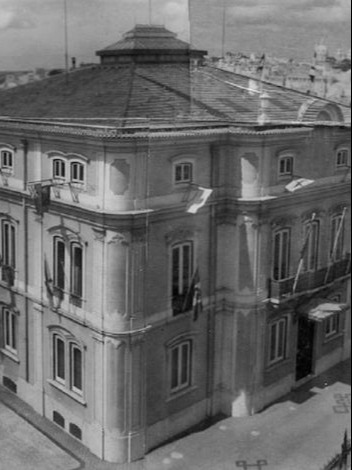
The Lisbon Branch of the Historical Association
Author: Andrew Shepherd
Report: Newsletter 31
Page:
Year: 2026
Subject Matter: British History
|
|
|
|
|
|
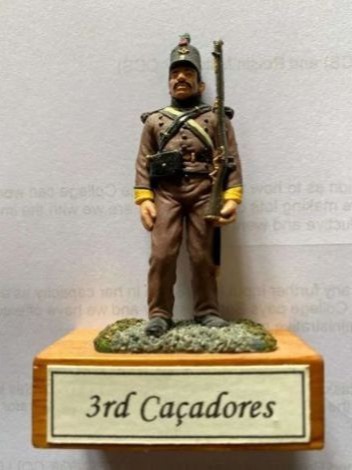
The Loyal Lusitanian Legion (Part II)
Author: Richard Tennant
Report: Newsletter 31
Page:
Year: 2026
Subject Matter: Peninsular War
|
|
|
|
|
The British in Portugal
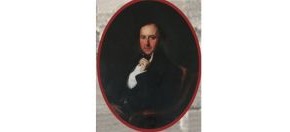
George Philips Dart was an Irish merchant who settled in Angra do Heroísmo on Terceira Island in the Azores. Four of his brothers also emigrated to the Portuguese islands, settling in Angra, Horta on Faial, and also in Madeira. Dart became the foremost exporter of oranges from Terceira to London. Growing wealthy, he was a major contributor to the resolution of the financial crisis in the Azores in the 1860s and 1870s, for which he was made a member of the Royal Military Order of Our Lord Jesus Christ in 1873. Dart was born into a Protestant family in Waterford, Ireland, on 31 May 1811. It is unknown when he arrived on Terceira Island, but he was certainly very young and was quickly making a good living as a wholesaler and as a merchant of agricultural products, with a shop on Rua do Salinas in Angra. By 1831, at the age of just 20, he had already made a loan of 10 contos de réis to the Treasury Board of the Regency of Angra, a sizeable sum. He owned several farms dedicated to production of oranges and became the foremost exporter of citrus from Terceira. The majority of the citrus produced in the Azores was not sold to mainland Portugal but to Britain. At that time, citrus was a luxury fruit in England, available only from November to May and mainly consumed at Christmas. Initially, British merchants went to the Azores at the start of the season to supervise the purchase and loading of the cargo but, later, many took their families with them and settled permanently on the islands. Cultivation of oranges flourished in the 18th century. This successful trade benefitted from the suitable growing conditions on the islands and from the geographical location of the archipelago. Additionally, at the end of that century producers obtained a competitive advantage over citrus from Seville as the Anglo-Spanish War had led to a British blockade of Spanish ports. By the mid-1800s over one hundred boats were employed in the trade, with quick schooners being favoured as the fruit was perishable. In 1854, 60 million oranges and 15 million lemons were recorded as going to the UK from the Azores. However, the accidental import of a leaf-attacking insect from Brazil, and other pests that came later, saw the demise of the industry in face of competition from California and Florida, which ironically had used parent trees from the Azores to establish their industry. Dart was a supporter of the Liberal cause during Liberal Wars (1828-1834). He was the first consular agent of Brazil in the Azores, being appointed in 1838, and also served as vice-consul on Terceira Island of both Austria (from 1842) and the United States (from 1850). As both a producer and a shipper, he made frequent visits to London, where yet another brother was the importer of his products and those of his brothers. Dart sent his children to school in England. He was an agent on Terceira Island of the Banco Nacional Ultramarino and, during the severe crisis of currency shortages and devaluation of the currency that affected the Azores during the 1860s and 1870s, he collaborated in the exchange of the old, devalued silver currency for the new one. Before that, much trade had been conducted using old Brazilian, British and other foreign banknotes. Dart contributed to the funds needed to withdraw Brazilian notes from circulation. Dart married Francisca Elísia de Sampaio e Lemos in 1839. As a Protestant, he had to request permission to marry from the Bishop of Angra, with the couple declaring that neither would renounce their religious convictions. Curiously, some of the children were raised Catholic and others Protestant. He inherited a large farm from his mother-in-law, on the outskirts of Angra, with a mansion, farmhouse, wine cellar, stables, and orchard. He sold this in 1860 after having acquired a plot of land on which he built his own house, a building that today houses the planning department of the Regional Government of the Azores. He died in Lisbon in 1885, and was buried in the Prazeres Cemetery. In his will, he requested that the funeral be held without pomp and according to Protestant rites. With his wife he had eight children, but only three had descendants. He also had three illegitimate children that he recognised. Main sources: Portuguese Wikipedia; Jorge Forjaz, Dart - Uma família irlandesa nos Açores e no Mundo. Casa dos Açores, 2017
|
|
|
|
50 Years Ago
The leading article of the 30th July 1976 edition of the Anglo-Portuguese News (APN) concerned itself with the newly elected President of Portugal, General Ramalho Eanes, aged 41. The article described his career in the infantry and his record of service at home and overseas. Full of patriotic zeal, it was he himself who said that he left Portugal carrying the Lusíadas in the pocket of his tunic. From the summer of 1975 Eanes began, with others, to pay serious attention to the political trend that seemed to be heading the country towards what the APN described as a new and bloodier dictatorship. He was one of the first to sign the so-called “Document of the Nine” which eventually halted the pro-Communist dictatorship. The APN considered that the people of Portugal had made an admirable choice in electing him. It noted that, in his few appearances on the TV during the election campaign, he displayed a good-natured firmness and studiously refrained from abusing his fellow candidates. His answers to questions at Press Conferences were masterly. Susan Lowndes Marques opened the edition of 13 August with an article entitled “A House in the Avenue d’Ièna”. “These are my children”, Calouste Gulbenkian used to say to the few friends that used to visit him in that astonishing house in Paris, as he waved his small plump hand towards the objects with which he was surrounded. And the exhibition on show in 1976 at the Gulbenkian Foundation Museum in Lisbon was an evocation of that house and its contents and its owner’s life, in commemoration of the 21st anniversary of his death and the 20th of the Foundation. The house in Paris was built by its owner in 1923-24, and was planned to show the collections that he had already acquired, although he constantly added to them in later years. Many of its contents were later sent to Lisbon to form the basis of the present museum’s collection. The contents of the 1976 Lisbon exhibition did not come from the museum’s permanent collection but were, according to Marques, “Gulbenkian’s menus plaisirs”; items which had a special intimate value and were good enough to be shown on their own merit. The edition of 27 August called attention to the newly formed International Lisbon Club, situated in the premises formerly occupied by the Royal British Club, which had entrusted the administration of the new enterprise to Leny and John Swibben of Dutch nationality and was officially opened on 3 September. The plan of the Swibbens was to organize periodically a national week for each of the foreign communities resident in Portugal. The restaurant was to feature the national cuisine and dishes of each country and there will be cultural and entertainment events of an appropriate kind. The 58 embassies in Lisbon were contacted to supplying material for their national weeks The British Historical Society of Portugal made one of its regular appearances in the APN in the edition of 10 September, this time in the form of a letter: Sir, The archives of the Society have now been collected in temporary accommodation granted to the Society in the Old English College – the Inglesinhos. As a result of several moves and several accretions, the archives are in disorder and a great deal of work will be necessary to reorganize them. May I appeal through your columns for helpers, whether members of the Society or not, preferably with previous experience, to help us in this work. Would volunteers willing to give an occasional day or holiday, on a regular basis, kindly get in touch with me at the address below? Richard Price, Chairman And, finally, in the same edition the Board of Governors of St. Julian’s School, announced the appointment of Mr. Thomas Andrew Bull as Headmaster as from 1 January 1977. Bull, who was born in 1934, had close connections with both Portugal and St. Julian’s. He was educated at the Oratory School near Reading and at Oriel College Oxford where he took an Honours Degree in History, later obtaining the Diploma of Education. Note: Andy Bull was a member of the Council of the British Historical Society of Portugal for many years. Edward Godfrey
|
|
|
|
|
|
|
Quiz
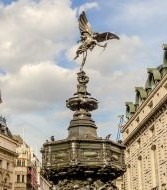
What was Piccadilly in London originally called?
|
|
|
|
Answer at the end of Members' News.
|
|
Book Review
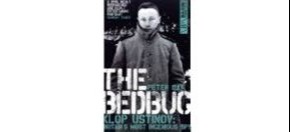
The Bedbug - Klop Ustinov: Britain's Most Ingenious Spy* by Peter Day Most people of my generation remember Peter Ustinov – screen actor, playwright, director, TV talk-show personality, UNESCO Goodwill Ambassador and, above all, raconteur extraordinaire. If you are of a different generation, just take a look at YouTube: you will not regret it. Today, his parents are much less well known. But his mother, Nadia Benois, was a portrait painter and a scenery and costume designer in London for many years. As for his father, his diminutive figure might have been seen at the bar in the Palácio Hotel in Estoril or bumped into somewhere in Lisbon during WWII. Unlike James Bond, 007, he did not have a licence to kill, but he was a spy. Although I am not sure that he saw himself as such. Indeed, on the guided tours on spies in Lisbon and the Estoril Coast he rarely gets a mention. Jona Ustinov was Russian by birth, Ethiopian and Jewish by ancestry, and German by passport, which meant that he fought most valiantly on the German side during WWI, the recipient of several Iron Crosses. He lived in the British Mandated Territory of Palestine for a while, was a great traveller in the Middle East and Eastern Europe, an incredible bon viveur and an outstanding chef, always invited to social gatherings. He was such a consummate performer that he turned himself into … an invisible decoy, for want of a better phrase. His fascinating story, told by Peter Day, is based on first-hand accounts in archives relatively recently released in Russia, Germany, the UK, and the US, along with fascinating anecdotes that touch on the lives of countless men and women, some later to become famous, others to remain shadowy figures on the world stage, is a resounding tribute to those who, in times of great danger for the Free World as we still know it today, were prepared to sacrifice their lives, their families, their all. Jona Ustinov, of Russian, Ethiopian and Jewish ancestry, went by the aliases of Mr Johnson or Mr Jonson, or U35. For family, friends, and enemies alike, he became known as Klop, the bedbug. Why a bedbug? Because he was very much a ladies’ man; “bedbug” speaking of clandestine affairs in seedy hotels, as his son was prone to believe for most of his adult life. A bedbug because, as his wife of some fifty years of unblissful matrimony knew, he needed to compensate for his diminutive stature and lack of good looks. Anybody who loved John Le Carré's books, or who is interested in the history of the Cold War, in the lives of real-life secret agents, of defectors, of double and triple intelligence operatives will be quite taken with Day's wonderfully researched book that runs from the Russian Revolution through two World Wars to the Cold War, under the very astute eye of the albeit little-known spy, the Bedbug. Ustinov was a scavenger of people's most innermost secrets, with a rare ability to see the big picture and to slot the pieces of information that he picked up into the right pigeon holes. In 1943, when in Lisbon, he had become a KGB agent, quite unwittingly, by acting under the orders of Kim Philby, MI6's counterespionage Head in the Iberian Peninsula; the would-be traitor of later years. What was at stake at the time was to make sure that all knew that the war was to be fought to the bitter end, namely until Germany's unconditional surrender, with no separate peace enabling the Allies to turn against the Communist regime. Along with the Spanish double agent, Juan Pujol Garcia, code-name Garbo, Klop would be pitting his wits against General Canaris and his men. This was with the help of the German spy, Otto John, who was to become, after the war, the first director of a West German equivalent of MI5. Ustinov's success cannot be put down to good luck: wherever he went he used all his tradecraft. A little incident in Estoril shows this most adequately. Under surveillance by four German detectives, after enjoying a lobster and Vinho Verde lunch at the Tamaris Restaurant with a fellow British spy, Klop rose to relieve himself and, minutes later, unbeknown to the German surveillance team outside, was sitting on the 1.15 train to Lisbon, the restaurant being endowed with a small door leading directly onto the station platform, later used, until recently, for discreet getaways after some lovers' rendezvous. Lisbon, along with the refugee camps in Caldas da Rainha, was deemed in 1944 to be a happy hunting ground for refugees, racketeers, double agents, double-crossers, smugglers, the stateless, the homeless, the arrivistes, local government officials, poverty-stricken peasants and the political police, all open to corruption and bribery. After WWII, a number of key names from all sides of the spy world, including the active Czechs in Lisbon, would end up on the wrong side of the Iron Curtain, forced into playing a part in the rebuilding of their country under Communist rule or forced into betraying their former employers, who they had already betrayed more than once during the war years. Day names them all in his book. Klop was determined to steer clear of all the post-war wheeling and dealing that still offer a hazy, wacky picture of the Intelligence Services worldwide today. He never became rich and died a poor man. The ultimate enabler of Secret Service deception operations was himself never caught, never interrogated, never betrayed, never imprisoned. He died in his bed, having lived his last years under the guise of an English country squire, in a dilapidated grace-and-favour farmhouse in Gloucestershire, befriending the local gentry, sharing drinks in the village pub, and intent on enjoying his new hobby of bird watching. Ninna Taylor *Biteback. 2015. ISBN: 9781849549097
|
|
|

|
Members' News
The Portuguese government has announced the creation of a National Commission for the celebration of the 900th anniversary of the founding of Portugal, under the former Deputy Prime Minister Paulo Portas. It is envisaged that the celebrations will span nearly two decades, structured around three major founding dates (1128, 1139, and 1143). The first three years will be dedicated to the Battle of São Mamede, which took place in 1128, a pivotal event in consolidating the political autonomy of the County of Portucale, the formation of the Kingdom of Portugal, and the consecration of Afonso Henriques as the first Portuguese monarch. The 900th anniversary will be commemorated in 2028. This will be followed by commemorations of the 900th anniversaries of the Battle of Ourique in 1139 and the Treaty of Zamora in 1143. We are very sad to report the death of Michael Pease. As we covered in a previous newsletter, Michael was a tireless campaigner for the selfless action of three Algarve fishermen, including a 13-year-old boy, to be formally recognised. In November 1943 they rescued, in very heavy seas, six crew from an American Liberator that ditched off the coast of Faro. Recognition finally came with a very attractive memorial that can be seen in the the Jardim do Largo de São Francisco in Faro. It was unveiled in 2022. On June 1, your Council members attended a Garden Party at the British Ambassador's Residence in Lisbon, together with many others representing the various activities of the British community in Portugal. We were honoured to meet and had an enjoyable discussion with the Duke of Edinburgh who, together with the Duchess, was in Lisbon as part of the celebrations of the 640th anniversary of the Treaty of Windsor. Several other members of the Society were also there, representing various other British community organisations. Our member, Roberto Cavaleiro, draws our attention to an excellent review by Alice Hunt in the London Review of Books of three publications on Catherine of Braganza when she was in England. While she is well known to our members, Hunt suspects that, outside of Portugal, the mistresses of King Charles II are better known these days than is his Queen Consort. One of the books reviewed is a detailed examination of Catherine's household accounts, giving a fascinating insight into her life in London. When she returned to Portugal in 1692, she took 103 members of her household with her. This very readable review gives an entertaining description of life at Court for Catherine, although it is definitely not for the prudish. The Society frequently pays attention to the history of the refugees, mainly Jewish, who passed through Portugal in WWII. So, members may like to know that two calçadas portuguesas have recently been installed in Lisbon as a memorial to that fact. One is in front of Rossio station, one of the main arrival and departure points for many refugees passing through Lisbon. The other is on Travessa do Noronha, on the site of the former Cozinha Económica Israelita, which provided shelter, food, and assistance to the refugees. The first member of the Reynolds family arrived in Portugal in 1825, and the family has been here ever since, working in the wine, cork and other businesses. Scattered lives, by Charles Waddy, explores the history of the family in Portugal, Britain, Spain and New Zealand between the Napoleonic Wars and the First World War. By kind permission of the family, we can make the book available to our members. It can be downloaded here. If you have yet to visit the main Gulbenkian museum since it re-opened in July, a visit is highly recommended. Consisting of pieces covering three millennia, the exhibition clearly demonstrates the aesthetic taste of Calouste Gulbenkian. Brilliantly curated, displayed and lighted, the exhibition is not to be missed. Our member Maj. General Rui Moura, recently presented a paper entitled From Tordesillas to Independence: the formation of Brazil's Territorial Borders, 1494-1822 at the 51st International Congress of Military History, which took place in Foz do Iguaçu, Brazil. There were participants from 29 countries. Rui will soon be making another presentation, this time in Lisbon at the 12th IBERCARTO Congress at the National Library and the Torre do Tombo, on the 15th and 16th in October, on the topic Geographic Information Systems in the Study of Military History. A new vision of the Lines of Torres Vedras (1810-1811) and the Sieges of Badajoz (1811-1812). Admission is free, subject to prior registration. Answer to Quiz: Piccadilly was previously called Portugal Street. It was originally named in honour of Catherine of Braganza who, of course, married King Charles II. Piccadilly was derived from "piccadills," a type of lace collar sold by a tailor on the street. The two names coexisted for a time, before Piccadilly won out, being the more common name by the 1740s. There is now a Portugal Street near the London School of Economics. STOP PRESS! STOP PRESS! Many members will have noticed that the Anglo-Portuguese News (APN) website has been offline for some considerable time. We are pleased to tell you that matters have recently been resolved. With a new url, the website is now hosted by the Municipality of Cascais and can be found here.
|
|
|
|
|
PRIVACY POLICY AND DISCLAIMER
The privacy policy of the British Historical Society of Portugal can be found on https://www.bhsportugal.org/terms-and-conditions. We use technical and organisational security measures to keep your information secure. This site uses specialist third party services to distribute this newsletter. The British Historical Society of Portugal holds no responsibility for the factual authenticity of the content of this newsletter and has made every effort to respect copyright law and personal privacy.
Carcavelos, September, 2026
|
|
|